| |
The
National Foreign Language Exam
System (Kratiko Pistopiitiko
Glossomathias-KPG) aims at measuring
levels of competence or proficiency
in English, French, German, Italian,
Spanish and Turkish. The target of
the exam battery is to assess
candidates’ ability to produce
socially purposeful meanings in
written and oral speech. The KPG
exams are governed by the Ministry
of Education, Lifelong Learning and
Religious Affairs, which, through
its Department of Foreign Language
Knowledge Certification, is
responsible for administering the
exams and for issuing the respective
certificates.
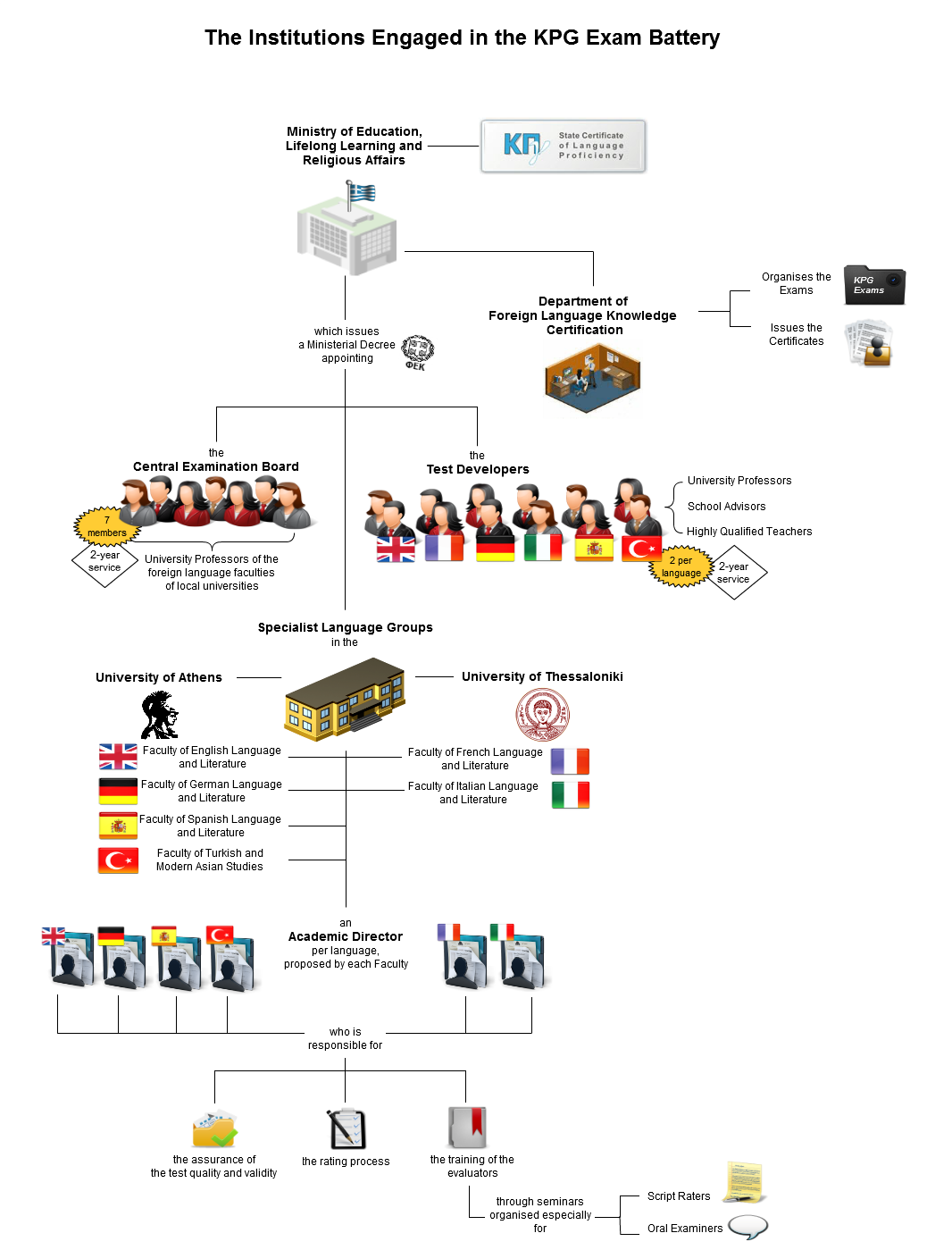
The Ministry of Education, Lifelong Learning and Religious Affairs has delegated
the organisation and the supervision of the test administration to the Central
Examination Board that consists of 7 members, all being distinguished University
Professors of the foreign language departments of local universities. They have
a two-year service on the Board and they are appointed by a Ministerial decree.
The Central Examination Board (henceforth CEB) is responsible for approving the
test paper content before it is disseminated to the state-selected exam centres
and it is also responsible for the specifications regarding the exam format, the
structure and the scoring regulations. Additionally, the CEB
functions in an expert consulting capacity, advising the Ministry on matters
regarding the development and growth of the system, exam policies and law
amendments, new and revised regulations. Apart from the Central Examination Board, there are also two Test
Developers per language, who can be University Professors, School Advisors or
highly qualified teachers. The Test Developers are also appointed by a
Ministerial decree for two years.
The foreign language departments of the University of Athens and the University
of Thessaloniki and their specialist language groups are responsible for the
development of test tasks in the languages that the KPG exam battery offers.
More specifically, the University of Athens is responsible for developing test
tasks in the following languages: English, German, Spanish and Turkish. The
University of Thessaloniki is responsible for the French and the Italian
language respectively. Each department has to select also an Academic Director,
who is responsible for: a) the rating process and b) the training of the raters
and the examiners.
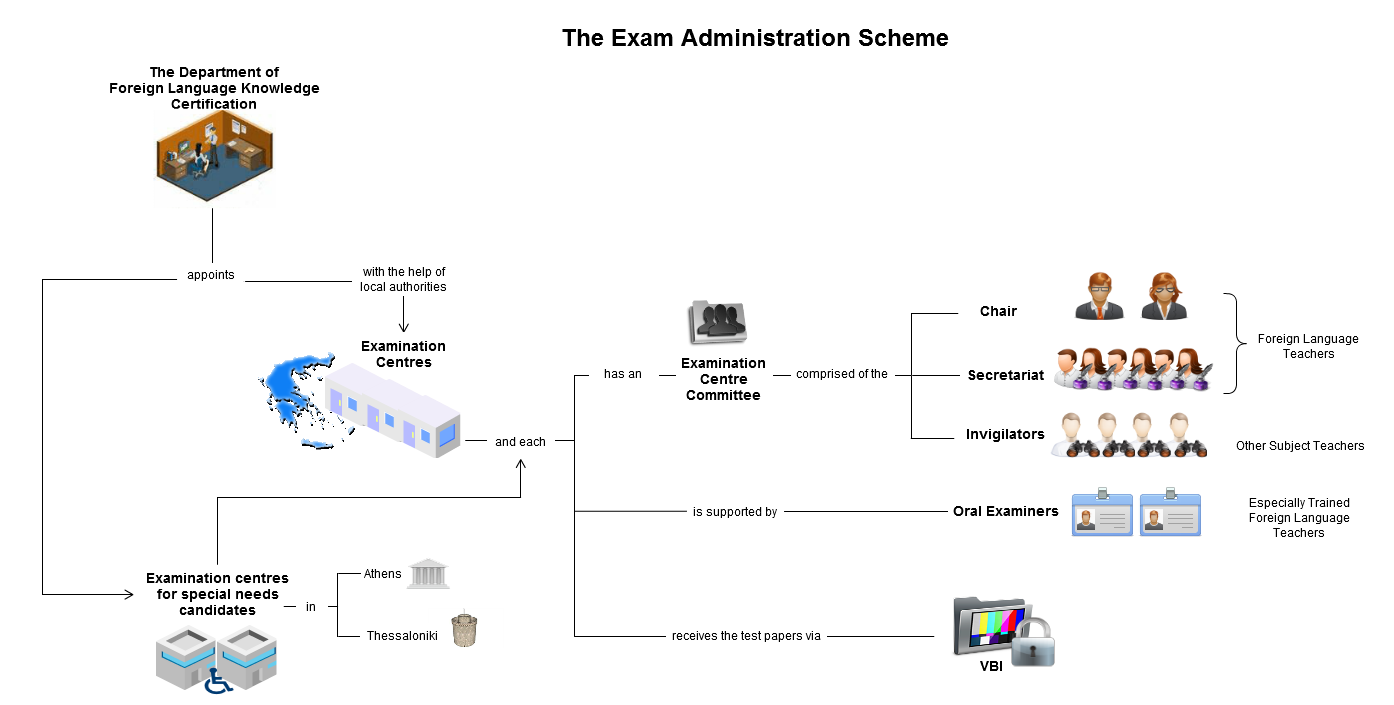
The exam dates are declared by the Minister of Education, Lifelong Learning and
Religious Affairs. During the administration of the exams, the Department of
Foreign Language Knowledge Certification along with the local authorities
determine which school premises across Greece will function as examinations
centres for the candidates. The school premises chosen are always fully equipped
with the necessary equipment. The number of the examination centres is
determined according to the number of candidates and the
geographical-transportation circumstances of every prefecture. Examination
centres are appointed across the country, even in areas with a limited number of
candidates than others. It has to be noted that there are also two examination
centres for candidates with special learning needs in Athens and Thessaloniki.
Each examination centre has a committee that is comprised of the chair, the
secretariat and the invigilators, who secure the effective administration of the
exam. Finally, the Ministry also appoints a number of examiners to each
examination centre that assess candidates’ oral performance. The test papers are
disseminated to the examination centres through the VBI (Vertical Blanking
Interval) system and the support mechanism that is also used for the
Pan-Hellenic university-entrance exams, ensuring thus the transparency and the confidentiality of
the exams.
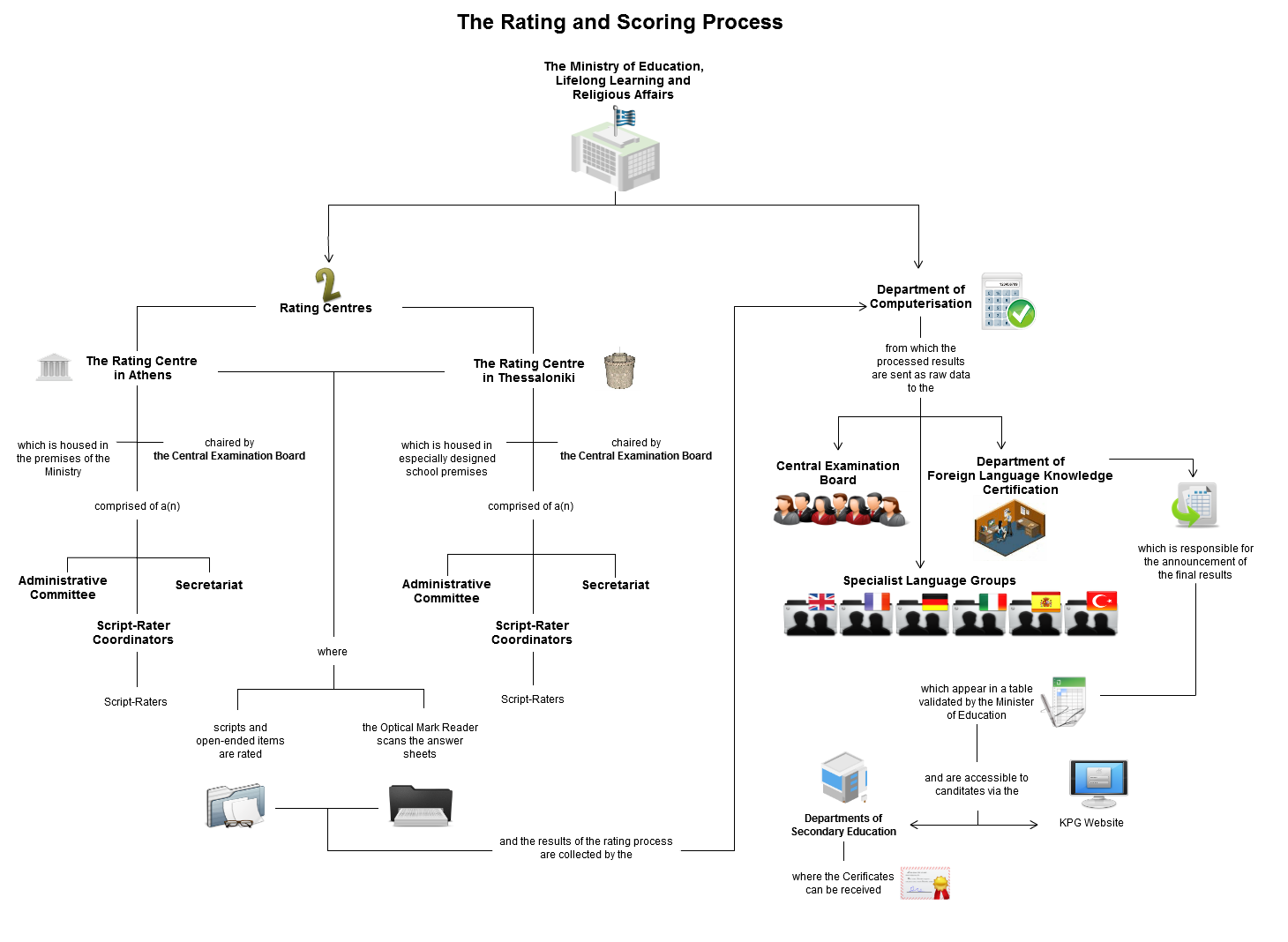
After the administration of the exams, the candidate booklets and the
candidate’s answer sheets are transferred to the two Rating Centres. The Rating
Centre in Athens is housed in the premises of the Ministry, while the Rating
Centre of Thessaloniki is housed in a school especially designed for the
purposes of an examination centre; both Rating Centres are chaired by the
Central Examination Board. In the Rating Centres, there are co-coordinators of
the script-raters that monitor the rating process and guide the script raters.
There is also an administrative committee and a secretariat that is comprised of
employees of the Ministry’s Department of Certification. The Rating Centres
gather the candidates’ answer sheets for all the languages that they are
responsible for. The Secretariat of the Rating Centre divides the candidates’
scripts into packages of 50 numbered scripts. The answer sheets are also divided
into packages of 50 for Module 1 and 3. The raters are asked to grade the
scripts for Module 2 and the short answers (open-ended items) for Module 1 and
3. Each script is graded by two raters, while the short answers are assigned a
grade by only one script rater. When the rating process is completed and the
answer sheets have been graded, they are scanned by the Optical Mark Reader.
Finally,
the results of the rating process
are collected by the Ministry’s
Department of Computerisation. The
results are then forwarded to the
Specialist Language Groups of every
language, the Central Examination
Board and the Department of Foreign
Language Knowledge Certification.
The final results are announced by
the Ministry of Education, Lifelong
Learning and Religious Affairs and
they appear in a table validated by
the Minister of Education, which
includes the names of all the
successful candidates. Candidates
can be informed about their final
scores by the Department of
Secondary Education, in which they
enrolled for the exams or via the
Internet (KPG’s website) by using
their individual access code.
Candidates, who have passed the
exams, can receive their
certificates from the Departments of
Secondary Education in which they
have registered for the exams.
The
Institutions Engaged in the
KPG Exam Battery
 |
The Exam
Administration
Scheme
 |
The
Rating and Scoring
Process
 |
|
|